4 min read
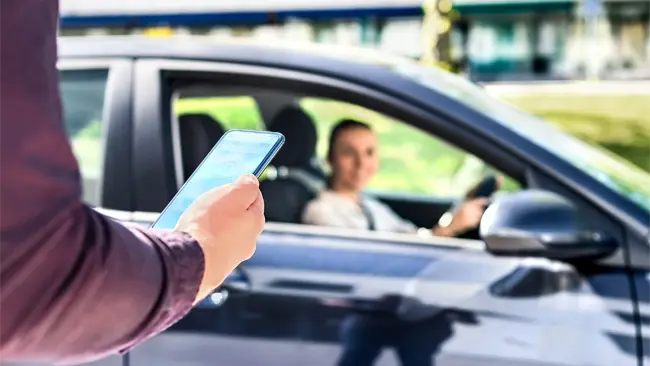
I handle a lot of car accident cases, and rideshare accidents come up often. These are accidents that involve drivers for companies like Uber or Lyft.
Handling insurance claims in these situations is tricky, and the rules are confusing. Whether you were a passenger, another driver, a pedestrian, or even the rideshare driver yourself, what you're entitled to depends on details that aren't immediately obvious.
Here's what I think everyone should know before they climb into the back seat—or before they pick up their next fare.
What law covers rideshare insurance coverage in Minnesota?
The specific rules are in Minnesota Statute § 65B.472, and they were written after Uber and Lyft started taking significant business from the taxi industry here in the Twin Cities. Those taxi companies already had insurance coverage rules, but these companies didn't—at least not at first.
Section 65B.472 focuses on these major points:
- It defines these companies as transportation network companies (TNCs)—essentially, companies that connect passengers to drivers through a mobile app.
- It sets the minimum insurance coverage that TNCs and their drivers must carry while operating in Minnesota.
- It then lays out how much insurance coverage has to be in place, depending on what the driver is doing at the time of an accident.
What coverage is available for rideshare-related accidents?
Under the statute, coverage requirements are divided into three “periods.”
- In Period 1, the driver is logged in to the app but hasn't accepted a ride yet.
- In this phase, the minimum required coverage is $50,000 per person or $100,000 if multiple people are injured.
- In Period 2, the driver has accepted a ride and is on the way to pick up the passenger.
- In Period 3, the passenger is in the vehicle (through drop-off).
- For Periods 2 and 3, the minimum required coverage jumps to $1.5 million.
Why the huge difference? Think of it like a commercial vehicle. In Minnesota, commercial vehicles over a certain weight must carry at least $1 million in coverage. That's because they're on the road for business purposes—they log far more miles than the average driver, and that creates more risk for everyone around them.
The legislature applied similar logic here. If a rideshare company is putting vehicles on Minnesota roads to generate revenue, the coverage needs to reflect that increased risk.
In a personal injury case involving a rideshare vehicle, I first try to determine which period applies. That tells me who the insurance carriers are, what coverage is available, and how to approach the case if my client were seriously injured.
What information do rideshare companies have to support a case?
More than you’d get from the vehicles themselves.
Most modern vehicles have a “black box”—the electronic data recorder that captures speed, braking, and other information at the time of a crash. But rideshare cases add another layer. The app itself also tracks GPS location, direction, and route data.
When I've requested this information in past cases, I've received spreadsheets showing, down to the second, exactly what the driver was doing before impact. That kind of evidence is powerful, whether you're trying to resolve a claim before filing suit or presenting a case at trial.
Rideshare companies know a lot about what happened in an accident. They’re just not always eager to share that information with you.
Would my personal insurance cover me as a rideshare driver?
Possibly, but it gets complicated.
The law allows insurance companies to exclude coverage for rideshare drivers who use their own vehicles. In other words, your personal policy may not apply while you're driving for Uber or Lyft.
In that case, you're largely dependent on the TNC's coverage policy to protect yourself. That's worth knowing before you ever start driving. Check your personal auto policy before committing to rideshare work.
What if I drive for a food delivery app?
This is an important distinction: Uber Eats, DoorDash, and other food delivery apps are treated differently.
Uber Eats may be part of the same parent company as Uber, but Uber Eats drivers transport food, not people. Therefore, under the law, Uber Eats does not qualify as a transportation network company, and the $1.5 million coverage requirement doesn't apply.
Your personal insurance policy might not work, either. Insurers have broad exclusions that cover any app-based driving work—not just passenger transport. But those exclusions are sometimes wider than what the law allows.
I've filed complaints with the Minnesota Department of Commerce over exactly this. In some cases, the insurance company has admitted the exclusion was improper and provided the coverage they were legally required to provide all along.
What about workers’ compensation coverage?
Rideshare drivers aren’t eligible for workers’ compensation coverage because they’re classified as independent contractors. They’re not considered “employees” of the TNC, so they can’t seek compensation from the TNC for injuries while on the job.
If you're seriously injured in a crash while driving for Uber or Lyft, the coverage available to you through the other driver's policy may not be nearly enough. And depending on your personal insurance exclusions, you may have limited protection on that front too.
If you’re planning to drive for a rideshare or food delivery app, I’d suggest talking to a workers' compensation insurance agent about purchasing your own coverage. It's not always cheap, but if you're ever in a serious accident, it could be the difference between being protected and being left without a recovery path.
What do I do if I’m in a rideshare-related accident as a passenger?
If you're riding in an Uber or Lyft, and the driver gets into an accident, your priority is obviously your safety. But if you're able to, here's what I'd encourage you to do:
- Start recording. Most phones have a voice memo or video feature. If you're in an accident and you have the presence of mind, use it. Record the scene, the drivers, and any witnesses. The app itself may offer a recording feature, but that recording belongs to Uber or Lyft—not to you. Record separately on your own device.
- Get witness information. Don't assume the police will track down everyone who saw what happened. Get names and phone numbers yourself.
- Photograph everything. Vehicle positions, damage, the intersection, traffic signals, road conditions—all of it.
- Ask questions and document the answers. If the other driver is accessible and cooperative, ask them what happened. Record it.
The facts on the ground—documented by you, in real time—can have a direct impact on your ability to recover.
If you or someone you know was hurt in an Uber or Lyft accident in Minnesota, we're here to help sort out what coverage applies. Contact Aaron Ferguson Law to schedule a consultation.
